Semaphore UI vs GitLab CI/CD

Denis GukovFounder & CTO at Semaphore UI
20 min read

GitLab CI/CD and Semaphore UI both run infrastructure automation. GitLab connects jobs to source review, testing and application delivery. Semaphore UI organizes Ansible, Terraform/OpenTofu and maintenance procedures as shared operations with inventories, credentials, launch forms and schedules. This comparison covers GitLab 19.5 and Semaphore UI 2.20.0.

Discuss this article with AI

Overview

An application release and a fleet-wide certificate check can use the same playbooks while needing different working routines. A release usually starts with a code change, produces an artifact and records its tests. Maintenance may start with an operator choosing a service, an environment and a prepared action. Both need reliable automation, but the people initiating the work and the configuration they handle are not always the same.

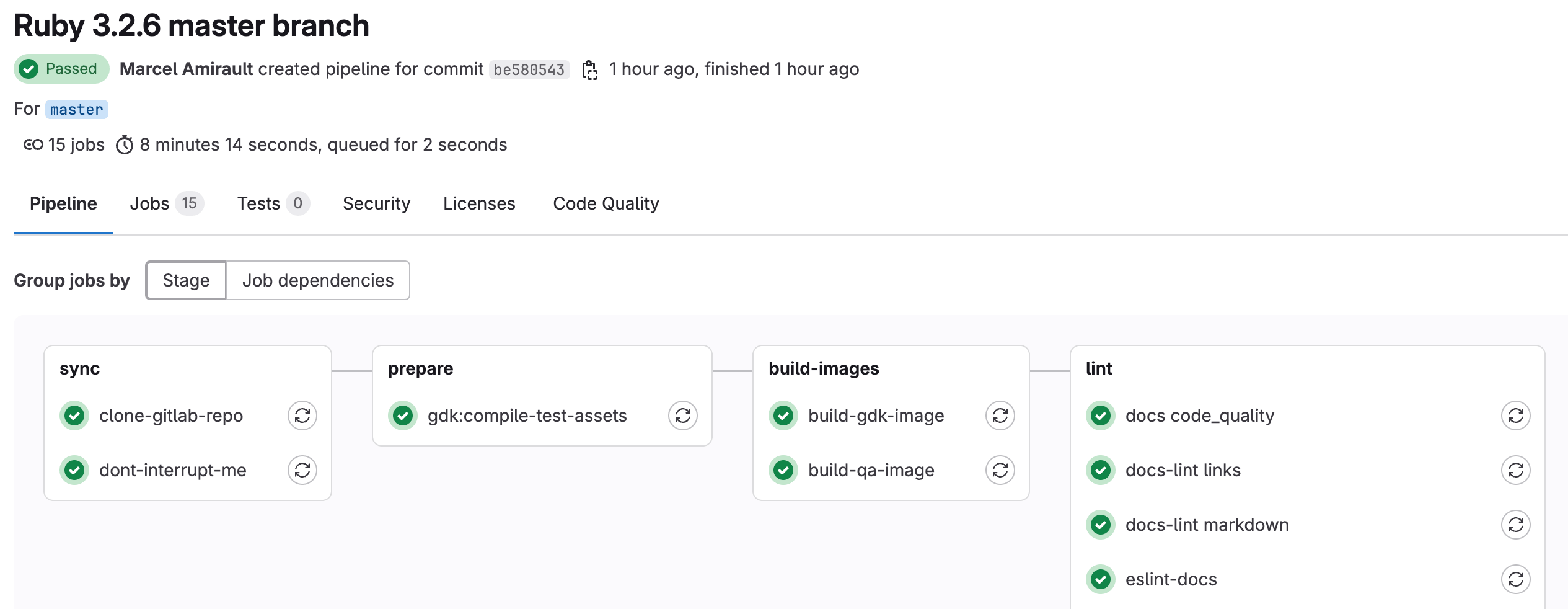
GitLab combines repositories, merge requests and CI/CD within a broader development platform. Pipeline YAML defines the jobs, GitLab Runners execute them, and results remain connected to the proposed code change. Manual launches and pipeline schedules also cover work independent of a new commit. GitLab.com, Self-Managed and Dedicated provide different ways to obtain and operate that platform.

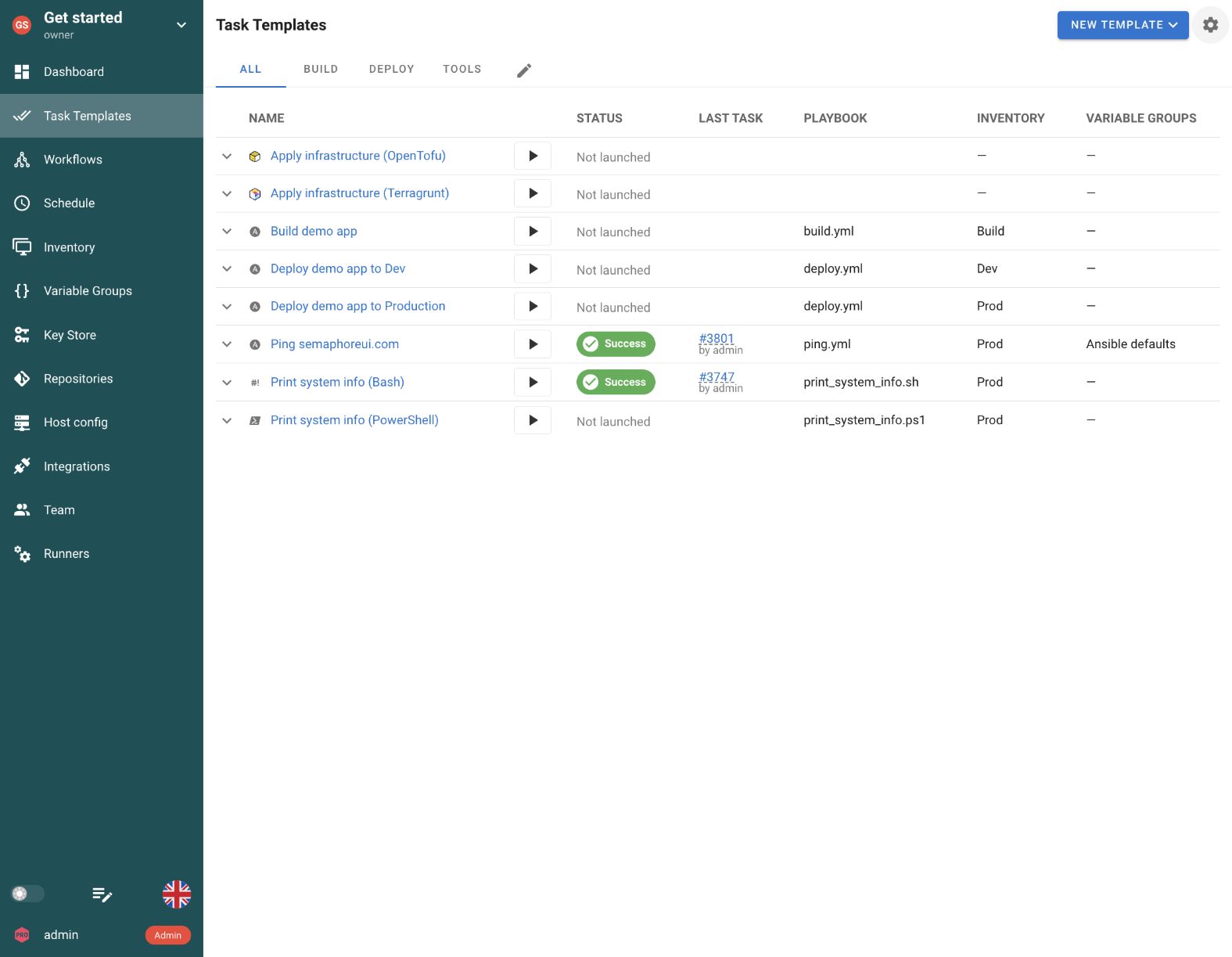
Semaphore UI connects to existing Git repositories and prepares automation through Task Templates. Ansible inventories, credentials and Variable Groups are shared project resources. Surveys collect run-specific values, schedules repeat prepared tasks and workflows join operations across supported tools. Playbooks can stay in GitLab while teams use Semaphore UI as the interface for deployments, provisioning and later maintenance.

Semaphore UI task templates for several automation tools in one project.
Semaphore UI. Prepared Ansible, Infrastructure as Code and command-line operations share a project’s task list.
GitLab pipeline details with jobs grouped by stage.
GitLab. Jobs grouped into pipeline stages. Official documentation example. Source

Quick comparison

For routine automation, both support manual launches, schedules and execution logs. The differences concern where engineers define the operation, how its targets and credentials are reused, and how closely its results belong to source review and delivery.

GitLab and Semaphore UI: key characteristics
Criteria Semaphore UI GitLab
Job configuration Tool-specific Task Templates .gitlab-ci.yml jobs and reusable components
Automation tools Ansible, Terraform/OpenTofu, Terragrunt, Bash, PowerShell, Python Command-line tools in runner jobs
Hosting Self-hosted, binary, packages, Docker or Kubernetes GitLab.com, Self-Managed or Dedicated
Execution On the server or runners GitLab Runners with shell, container or Kubernetes executors
Ansible inventory Reusable inventory resources, files in Git and Ansible discovery plugins Inventory files and discovery plugins configured in the job
Inputs and variables Surveys, Variable Groups and inventory variables Typed pipeline inputs, CI/CD variables and environment scopes
Workflows Visual graph connecting tool-specific Task Templates YAML pipelines, job dependencies and reusable components
Credentials Key Store and external secret-store integrations CI/CD variables and external secret integrations
Access control Project roles, Enterprise custom roles and template permissions Group and project roles, protected branches and environments
Terraform state Built-in HTTP backend in Pro, or external backend GitLab-managed HTTP state backend, including Free
License and plans MIT Community, Pro and Enterprise MIT Community Edition, commercial Enterprise Edition capabilities

Semaphore UI gives the team a place to reuse an inventory, its connection credentials and the variables required by several playbooks. A task can be available as a form for a colleague, a scheduled maintenance operation or a step in a provisioning workflow. GitLab provides its own reusable pipeline configuration and variables, with stronger ties to merge requests, artifacts and deployment environments. The distinction is the configuration model around the automation, not whether either product can run a maintenance command.

Feature comparison

Consider the full life of an environment: provision it, configure its hosts, deploy a release and continue maintaining it. The same code may take part in several of those steps. What changes is how the platform reuses targets and credentials, collects inputs, executes the work and connects the outcome to the next action.

Installation and setup

A shared automation service needs a host, a database and an upgrade process. Those requirements matter even when the work is a nightly backup rather than an application build.

SupportedPartially supportedNot supported
Installation and setup: GitLab and Semaphore UI
Criteria Semaphore UI GitLab
Self-hosted deployment Yes Yes
Native Linux packages Yes Yes
Native Windows server Yes NoSupported server runs on Linux
Kubernetes deployment YesHelm chart YesHelm chart or Operator

GitLab.com provides Git hosting, CI/CD and the surrounding platform as a managed service. For Self-Managed GitLab, Linux packages, Docker and Kubernetes installations include several cooperating services, such as PostgreSQL, Redis and background workers. A team that already operates GitLab can use that installation for automation without adding another web service.

Semaphore UI can run as a standalone binary, native Linux package, Docker container or Kubernetes deployment, with its application service and database. Native server binaries also cover macOS, Windows and FreeBSD. This gives a team that only needs an automation interface a smaller application to deploy alongside its existing Git host.

Server and worker platforms are different choices. GitLab Runner can run on operating systems including Windows and macOS even though the supported Self-Managed GitLab server runs on Linux. Ansible execution needs a supported control environment, such as Linux, WSL or a Linux runner, even when Semaphore UI’s web service runs on Windows.

Automation tools and IaC

Provisioning, configuring hosts and maintaining services often use different tools. The distinction is how each operation is prepared and reused, rather than whether a shell can invoke its command.

SupportedPartially supportedNot supported
Automation tools and IaC: GitLab and Semaphore UI
Criteria Semaphore UI GitLab
Ansible playbooks YesTask Template YesPipeline job command
Terraform/OpenTofu YesTask Template YesPipeline job command
Terragrunt YesTask Template YesPipeline job command
Bash YesTask Template YesPipeline job command
PowerShell YesTask Template YesPipeline job command
Python YesTask Template YesPipeline job command
Built-in Terraform state storage YesProHTTP backend YesHTTP backend, including Free

GitLab jobs run commands defined in pipeline YAML, using tools installed on the runner or provided by a container image. Ansible, Terraform/OpenTofu and Terragrunt can therefore take part in the same pipeline as tests and deployments, or in a standalone maintenance pipeline. GitLab also documents OpenTofu components and infrastructure workflows for changes reviewed through merge requests.

Semaphore UI gives Ansible, Terraform/OpenTofu, Terragrunt, Bash, PowerShell and Python their own Task Templates. Engineers select the repository, tool settings, credentials and shared variables in the interface, while the automation code stays in Git. A Terraform provisioning task or Python readiness check can run independently, on a schedule or within a workflow. This suits teams that want shared launch settings maintained in Semaphore UI and prepared operations available through the interface. Pipeline YAML is useful when changes to the orchestration itself, including job sequencing and configuration, need code review and version history.

For provisioning, Semaphore UI Pro adds an HTTP state backend with workspaces, version history and UI management. Shared Terraform/OpenTofu state can stay with the prepared IaC operations instead of requiring another service. GitLab-managed Terraform/OpenTofu state is available in Free and also supports an HTTP backend and locking. Existing external backends remain an option for either product. Semaphore UI’s default plan and apply commands disable locking unless overridden, so backend support alone does not enable it for those runs.

Repositories need not move just to introduce Semaphore UI. A project can register several Git repositories with their own URLs, branches and credentials, then select the appropriate one in each template. GitLab CI/CD also works with external Git hosts: its Premium and Ultimate external-repository integration creates a mirrored GitLab project. Pipeline configuration can live at an alternate path, in another project or at an external YAML URL, and a job can clone another repository explicitly. GitLab pipelines still belong to a GitLab project. Semaphore UI’s operations project can therefore sit alongside the team’s existing Git hosts, while GitLab remains an option for both delivery and maintenance pipelines.

Saved operations and schedules

A service restart, certificate renewal or application release should retain its configuration. Colleagues then select the operation, provide the changing inputs and run it manually or on a schedule.

SupportedPartially supportedNot supported
Saved operations and schedules: GitLab and Semaphore UI
Criteria Semaphore UI GitLab
Job definitions without CI/CD YAML YesTask Template form NoPipeline YAML required
Launch input forms YesRequired fields, integer checks and choices YesTyped inputs, choices and regex validation
Shared variables YesVariable Groups YesGroup and project variables
Scheduled runs Yes Yes
Build versions and deployment selection YesLinked Build and Deploy templates YesPipeline jobs and artifact/version references
Saved repository connections YesNamed project repositories reused by templates YesProject repository and CI/CD configuration

GitLab defines jobs in pipeline YAML. Its pipeline editor validates and visualizes that configuration, and its Pipeline Wizard generates a configuration file that is committed to a repository. Semaphore UI’s Task Template form saves an operation by selecting its tool, repository, inventory and Variable Groups, without a CI/CD YAML definition. This concerns how engineers maintain the saved procedure. Both products can launch existing jobs manually with inputs or on a schedule, without a new commit for each run.

GitLab pipeline inputs are typed parameters declared in YAML, with defaults, allowed choices and regex validation. Group and project CI/CD variables provide reusable configuration, including environment scopes. A colleague supplies those inputs when starting the prepared pipeline, while the pipeline schedule supplies the configuration for unattended runs.

Semaphore UI keeps the reusable configuration in the Task Template, selected inventory and Variable Groups. Surveys expose launch values with required fields, integer checks and predefined choices. They do not provide GitLab’s configurable regex rules. For example, an engineer can prepare a service operation with choices for service name, desired state and environment. The colleague fills in that form, starts the task and reads its status and output. The playbook implements the requested action, while the shared resources supply the repository, hosts and connection details.

Semaphore UI also links Build and Deploy templates. A build records a version, and a deployment selects a successful build version or starts automatically after a successful build. The automation publishes and retrieves the package or image from the team’s chosen storage. GitLab represents that release through pipeline jobs, artifact references and deployment environments, with integrated test and delivery evidence.

The same setup supports unattended work. A certificate-check template can run nightly against the environment’s inventory and report failure when the playbook finds a certificate close to expiry. A cron expression such as 0 2 * * * schedules it daily at 02:00 in the configured scheduler timezone, UTC by default. One-time schedules cover a planned maintenance window. GitLab can schedule the equivalent playbook too, using its pipeline schedule and configured inputs.

Inventory

Host maintenance depends on a reusable definition of the targets and their connection settings. A patching run, backup and certificate check can share that definition.

SupportedPartially supportedNot supported
Inventory: GitLab and Semaphore UI
Criteria Semaphore UI GitLab
Reusable Ansible inventories YesUI-managed inventory resources YesInventory files and plugins in jobs
Dynamic host discovery YesAnsible inventory plugins YesRun Ansible inventory plugins in the job
Host selection at launch YesAnsible limit prompt YesPipeline input passed to Ansible limit

Semaphore UI makes an inventory a named project resource that templates can share. It can contain editable INI/YAML, reference a file in Git or use Ansible’s dynamic inventory plugins. The selected inventory also holds host and optional sudo credential references, so changing the target configuration does not require editing every maintenance operation.

GitLab can use the same Ansible files and discovery plugins. A job fetches the inventory from its repository or another configured source, installs the required discovery plugin and passes selected inputs to Ansible. Both can discover hosts from cloud APIs or other systems supported by the installed Ansible plugins. Semaphore UI’s difference is the reusable inventory object and connection settings in the operations interface.

For a recovery task on one server, a permitted Ansible limit narrows the run without creating a new inventory. This selects hosts within one task, rather than automatically splitting the fleet into independent jobs. An inventory in Git remains useful in either product when its changes need review.

Execution

Execution must reach the target network with the correct dependencies. Worker placement and per-job isolation are separate from how the web server is installed.

SupportedPartially supportedNot supported
Execution: GitLab and Semaphore UI
Criteria Semaphore UI GitLab
Remote execution YesRunners YesGitLab Runners
Containerized jobs YesProDocker executor YesDocker executor
Kubernetes job pods YesEnterprise YesKubernetes executor
Runner routing YesProRunner tags YesRunner tags
Project execution workers YesProProject-assigned runners YesProject runners

GitLab Runners execute jobs with shell, Docker or Kubernetes executors. Semaphore UI can execute on its application server or on a runner near the managed systems. Both let a team place execution inside a private network while keeping the shared interface elsewhere.

GitLab supports project-specific runners and tag-based job routing. Semaphore UI Pro adds project-assigned runners, tag-based routing and per-task Docker execution. Enterprise adds Kubernetes task execution. These settings let a team select execution capacity with the required connectivity and dependencies. Installing the application server in a container remains separate from choosing a container runtime for each job.

Workflows

Provisioning a host, configuring it and verifying its service combines several saved operations. Failures and approval points determine whether the next step should run.

SupportedPartially supportedNot supported
Workflows: GitLab and Semaphore UI
Criteria Semaphore UI GitLab
Graph-based workflow editing YesConnect saved templates visually NoEdit YAML, visualize the resulting graph
Success and failure branches YesVisual workflow connections YesSuccess/failure jobs and needs dependencies
Pause for a manual decision YesWorkflow approval YesBlocking manual job
Separate approval permission No YesPremiumProtected-environment deployment approvals
Passing values between jobs Yes YesDotenv report artifacts
Files between jobs PartialConfigure storage and transfer YesJob artifacts
Reusable multi-step components PartialReuse tasks, rebuild the sequence YesCI/CD components

Semaphore UI workflows connect the saved operations when a procedure spans several tools. An OpenTofu task can create an environment, an Ansible task configure its hosts and a Python task register it with another system. Success and failure branches direct the next step, and an approval can pause the sequence before a change. The templates remain available separately for later maintenance, so running a diagnostic does not require replaying the entire provisioning procedure.

Semaphore UI’s workflow editor lets an engineer connect saved templates and configure their success or failure paths on a graph. GitLab’s pipeline editor edits and validates YAML, then visualizes the resulting jobs and needs dependencies. The visualization helps inspect the procedure, while changes to its connections remain changes to the pipeline configuration. This matters when the operator wants to assemble existing procedures visually instead of maintaining their orchestration in YAML.

GitLab can pass computed values to later jobs through dotenv report artifacts, such as a deployed version or environment URL. Complex JSON or multiline data uses a regular file artifact instead. Provisioning and configuration can pass structured values between Semaphore UI tasks. A Terraform/OpenTofu output containing a new host address, for example, can become an input for the next operation. In 2.20, output collection covers Ansible set_stats, Terraform/OpenTofu/Terragrunt outputs and JSON from Bash, PowerShell or Python using the local executor on the server or a remote runner. Docker and Kubernetes task executors do not produce those workflow outputs. The receiving template declares the input, which its playbook or inventory configuration then uses to target the new host.

GitLab can pause a pipeline with a blocking manual job in every plan. Set when: manual with allow_failure: false, because optional manual jobs do not block the pipeline. Premium and Ultimate deployment approvals add independently assigned approval requirements for protected environments. Semaphore UI 2.20 workflow approval follows permission to run project tasks, with a separate approver role announced for 2.21. Use GitLab’s protected-environment approvals when that independently managed approval boundary is required.

Files need a different path. A compiled package or saved Terraform plan must be stored where the next operation can retrieve it, or transferred explicitly. GitLab’s job artifacts already cover that part of a delivery pipeline. When Semaphore UI handles deployment, its automation can fetch the published artifact using the version or digest supplied by CI. This retains GitLab’s build evidence while allowing the subsequent host operations to use Semaphore UI’s inventories, credentials and run history.

GitLab CI/CD components package versioned, reusable pipeline configuration, including sequences of jobs. Semaphore UI reuses individual Task Templates, while the sequence is defined in each workflow and cannot be inserted as one nested workflow. Components are valuable when many delivery pipelines must share a maintained multi-step process. Semaphore UI’s model is useful when teams primarily reuse the underlying operations and connect them differently for provisioning, deployment or recovery.


Access control and sign-in

The person running a prepared operation may not be the engineer who changes it. Project permissions, narrower execution rights and sign-in controls solve different parts of that delegation.

SupportedPartially supportedNot supported
Access control and sign-in: GitLab and Semaphore UI
Criteria Semaphore UI GitLab
Project-level RBAC YesProject roles YesGroup and project roles
Run without project administration YesTask Runner YesDeveloper role, can also push code
Deployment execution controls YesEnterpriseTemplate permissions YesPremiumProtected environments
LDAP sign-in YesPro YesSelf-Managed
OpenID Connect sign-in YesPro YesSelf-Managed
Multi-factor authentication YesProLocal TOTP or identity provider YesLocal authenticator or passkey

GitLab uses group and project roles, with additional controls for protected branches and environments. The standard Developer role can run pipelines and also push code to non-protected branches. For deployment-only access without those code-contribution permissions, Premium and Ultimate support invited Reporter-role groups with access to a protected environment. Teams delegating operations through GitLab configure that deployment boundary explicitly.

Semaphore UI gives an operations team its own project boundary around templates, inventories, repositories, credentials and Variable Groups. Community already separates project administration from execution: Task Runners can launch project templates and have read-only access to the other resources. Engineers can maintain the prepared configuration while colleagues run the procedures the project makes available.

Enterprise custom roles and template-level permissions narrow that further. A support colleague can have a Guest base role with a custom role granting execution on a particular restart template, instead of project-wide Task Runner access. Its inventory, credentials and launch options are prepared by the engineer. This is useful when the delegated action is more specific than membership of the whole operations project.

The form is the interface to the procedure, not a substitute for its access rules. Automation code and allowed launch overrides must keep an operation within its intended targets. Semaphore UI’s template permissions do not provide separate inventory and credential permissions for arbitrary combinations of resources.

GitLab Self-Managed supports LDAP and OpenID Connect, while GitLab also provides account-level two-factor authentication. Semaphore UI Pro provides local TOTP and supports LDAP and OIDC. Central identity verifies who is signing in, while project roles and template permissions still define which operations that person can run.

Secrets

An operator should select the prepared connection rather than repeatedly paste passwords into launch inputs. Existing vaults can supply those connections without becoming job parameters.

SupportedPartially supportedNot supported
Secrets: GitLab and Semaphore UI
Criteria Semaphore UI GitLab
Stored secrets YesKey Store and secret variables YesMasked or hidden variables
HashiCorp Vault YesPro YesPremiumConfigured job secret
AWS Secrets Manager YesEnterprise YesPremiumConfigured job secret
Azure Key Vault YesEnterprise YesPremiumConfigured job secret
External OpenBao secrets YesProKey Store integration YesCLI retrieval configured in the job
Devolutions Server credentials YesEnterpriseKey Store integration YesCredential API call configured in the job
CyberArk secrets YesEnterprisePVWA REST API storage YesCCP retrieval in an Ansible job

GitLab jobs use CI/CD variables that can be masked or hidden, and Premium external-secret integrations request values from services such as HashiCorp Vault, AWS Secrets Manager, Azure Key Vault and Google Cloud Secret Manager. GitLab 19.5 also offers OpenBao-based Secrets Manager for Premium and Ultimate, billed through GitLab Credits for online licenses, with an add-on for offline Self-Managed licenses. Jobs explicitly request its secrets, with access governed by configured permissions and recorded in audit events.

Semaphore UI’s Key Store distinguishes SSH keys from login/password credentials, including passwords and access tokens. A repository selects its checkout credential, an Ansible inventory selects host and optional sudo credentials, and the template can use an Ansible Vault password. These relationships are part of the saved operation, so a colleague launching a certificate renewal or service task does not need to paste each connection secret into the survey.

For a team already operating a vault, Semaphore UI Pro integrates HashiCorp Vault and OpenBao. Enterprise adds AWS Secrets Manager, Azure Key Vault and Devolutions Server. For the same deployment, GitLab supplies secrets through job variables or configured secret integrations. Semaphore UI attaches credential references to repositories, inventories and templates, so operators reuse the prepared connections at launch. A command can also retrieve a secret directly where a native integration does not cover the required service, with that retrieval configured and maintained by the team.

For OpenBao and Devolutions Server, Semaphore UI provides named Key Store integrations in Pro and Enterprise respectively. GitLab jobs can retrieve an OpenBao value through its CLI or a Devolutions Credentials entry through its API. The team maintains that authentication, retrieval and injection in the job, rather than selecting a saved Key Store connection. This is a viable route when the existing vault and job code already cover the procedure.

Semaphore UI Enterprise integrates CyberArk through the PVWA REST API. A GitLab job running Ansible can retrieve CyberArk credentials through the cyberark.pas collection and Central Credential Provider, with the collection and application authentication configured in the job runtime. These use different CyberArk interfaces, so the integration must match the CyberArk service the team operates.

Logs and audit

After patching or deployment, the team needs both execution results and a record of who changed or launched the operation. Those records answer different questions.

SupportedPartially supportedNot supported
Logs and audit: GitLab and Semaphore UI
Criteria Semaphore UI GitLab
Execution history and logs Yes Yes
Ansible result presentation YesProBuilt-in host/task summary YesConfigured Ansible JUnit callback and report publishing
Administrative audit history YesEnable recording, administrator view YesPremiumProject and group audit events
SIEM forwarding YesProTLS Syslog or Splunk HEC YesUltimateGroup audit event streaming

Semaphore UI retains task status, launch details, repository revision and output. Pro adds an integrated Ansible host/task summary, making a fleet-wide failed check easier to follow to affected hosts. GitLab retains job logs and can display Ansible results through configured JUnit report artifacts. Test reports also feed the merge-request and pipeline views, which are useful when infrastructure checks are part of a code review.

For access reviews and incident investigations, Semaphore UI records authentication, resource changes and task activity when audit logging is enabled. Its administrator audit view spans projects in every edition. GitLab Premium and Ultimate provide group and project audit pages, while Free account history covers successful sign-ins. GitLab audit permissions and event types follow the group, project and instance scope.

Semaphore UI Pro adds filtering, CSV or JSONL export and TLS Syslog or Splunk HEC forwarding. GitLab Ultimate streams group audit events as JSON to external destinations. Both can feed a security information and event management (SIEM) system, but the events and scope differ from ordinary job output.

Integrations

A release event or monitoring system can start a prepared operation and send its result to the team. The useful comparison is how much of that connection is configured in the product.

SupportedPartially supportedNot supported
Integrations: GitLab and Semaphore UI
Criteria Semaphore UI GitLab
Launch and inspect jobs by API Yes Yes
Incoming webhook triggers YesRequest matchers and value extractors YesPipeline trigger webhook
Chat notifications YesSlack, Teams, Telegram and other channels YesProject notification integrations

Semaphore UI provides an authenticated task API and incoming integration endpoints. Matchers filter a request, and extractors map headers or body fields to task inputs. GitLab exposes pipeline trigger APIs and webhook URLs that start a pipeline for a branch or tag. Its project integrations also connect delivery events to issue trackers and external services. A monitoring alert can therefore start a prepared diagnostic without a new code commit.

Semaphore UI includes email, Slack, Microsoft Teams, Telegram, Rocket.Chat, DingTalk and Gotify notification channels. Templates and project alerts select where results go. GitLab provides project integrations such as Microsoft Teams notifications, pipeline-status emails and its Slack app. A notification link helps colleagues inspect a run, but is not itself approval from inside chat.

AI-assisted automation

A coding assistant can help prepare an operation or investigate a failed run using documented APIs, configuration examples and the relevant output.

SupportedPartially supportedNot supported
AI-assisted automation: GitLab and Semaphore UI
Criteria Semaphore UI GitLab
MCP access YesCommunity connector YesGitLab MCP server

Both products provide public documentation and APIs that assistants such as Claude Code and Codex can consult when drafting configuration or investigating job output. GitLab pipeline YAML gives the assistant the delivery configuration, while Semaphore UI’s API exposes the saved operation and its project resources. This supports assistance with setup and troubleshooting without making generated changes automatically correct.

GitLab 19.5 includes a generally available MCP server, with available tools depending on access and licensed features. Semaphore UI has a community MCP connector for its API and has announced official MCP support for Pro in version 2.21.0. Connector access follows the account and credentials supplied to it, so an assistant should receive the scope appropriate to the operation.

Licensing and support

GitLab covers the development platform around the automation, while Semaphore UI supplies a focused service for running it. The economic comparison depends on which of those responsibilities the team needs to buy and operate, including systems it already has.

Open-source and commercial options

GitLab Community Edition is MIT-licensed, while Enterprise Edition includes separately licensed commercial capabilities. Free, Premium and Ultimate plans cover different requirements, with deployment approvals and the documented native external-secret integrations requiring Premium. GitLab-managed Terraform/OpenTofu state is available in Free. Hosted offerings include compute and storage allowances, while self-managed runners use infrastructure supplied by the team.

Semaphore UI Community is MIT-licensed and covers core templates, project roles, schedules and workflows. Pro and Enterprise add capabilities within the same product family. All current Semaphore UI plans are self-hosted. For a team that already has a Git host and needs an Ansible and IaC service, this keeps the new service focused on operating automation rather than introducing a broader development platform solely for those jobs.

Paid capabilities and support

Semaphore UI Pro adds the state backend, project runners and per-task Docker execution discussed here. Enterprise adds Kubernetes task execution, custom roles and template permissions. The edition decision follows the required execution and delegation model, rather than every operator needing an advanced control.

GitLab Free does not include technical support, while Premium and Ultimate include vendor support with response targets based on support impact. Semaphore UI Community provides best-effort assistance, Pro includes business-time vendor support, and Enterprise offers tailored support commitments and assistance with onboarding, configuration, upgrades and migration. Compare the actual plan and agreement for the environment being operated.

Maintenance and ownership

For the same deployment or maintenance procedure, GitLab keeps commands, sequencing and configuration references in pipeline YAML. Semaphore UI keeps its tool settings, inventory, credentials and Variable Groups with reusable Task Templates. Moving those operations to Semaphore UI can replace their CI configuration while the automation code and its reviews remain in GitLab. Keeping the jobs in GitLab is reasonable when its launch inputs, permissions and execution model already fit the people operating them.

How to choose

Choose based on the people using the automation and the resources the platform should organize for them. The ability to run a command is shared. The larger difference is whether the surrounding work is a delivery pipeline, a prepared infrastructure operation or both.

When to choose GitLab CI/CD

Choose GitLab CI/CD when automation needs to stay closely connected to the development and review process.

  • Code review, tests and artifacts form one chain. Infrastructure and application changes are verified in merge requests, with pipeline results and deployment evidence kept alongside them.
  • Pipeline components and environment controls are essential. Many projects share versioned sequences of jobs, or deployments rely on protected-environment approval rules.
  • The existing pipelines serve operators effectively. Their inputs, schedules, runners and access controls already cover the maintenance work without a separate interface.

When to choose Semaphore UI

Choose Semaphore UI when sharing and operating infrastructure automation is a distinct need, even if the code remains in GitLab.

  • Ansible inventories and credentials are reused daily. Patching, diagnostics, certificate work and deployments share target environments rather than each becoming a separate job-configuration exercise.
  • Colleagues need prepared operations. Engineers maintain templates and shared configuration, while operators use surveys, schedules and task history. Community project roles cover shared execution, with Enterprise permissions for specific templates.
  • The procedure spans several automation tools. Direct Terraform/OpenTofu, Terragrunt, Bash, PowerShell and Python templates join Ansible operations in one workflow and remain independently reusable.
  • The service should fit existing infrastructure. Binary, package and Docker installation options let the team host the operations interface alongside its existing Git service, with runners placed near private systems.

Using Semaphore UI with GitLab CI/CD

For an application release, GitLab can review the code, run tests and publish a container image or versioned package. A pipeline job then sends that immutable artifact reference to a prepared Semaphore UI deployment template through the authenticated task API. Semaphore UI uses its saved inventory, credentials and variables to deploy through a runner with access to the target environment. The deployment automation retrieves the artifact from the team’s registry or repository.

The GitLab job must retain the returned task identifier, check the final task status and map it to the pipeline result. Acceptance of a launch request only queues the task. An incoming webhook can trigger an operation too, with completion reporting implemented by the integration. This is a connection the team builds through the APIs, rather than an automatic two-way deployment integration.

After the release, colleagues can use Semaphore UI for diagnostics or a service restart, while a nightly certificate-check template continues on its schedule. Those operations use the prepared infrastructure configuration independently of a new commit. GitLab retains source review, test reports and artifact history, while Semaphore UI provides the daily interface to the running environment.

FAQ

Can GitLab CI/CD run Ansible and infrastructure maintenance?

Yes. Jobs can invoke Ansible, Terraform/OpenTofu and other command-line tools through their runner environment. They can run manually or on schedules without a new commit. Semaphore UI adds a different configuration model through tool-specific templates, shared inventories, credentials and Variable Groups.

Can playbooks stay in GitLab when using Semaphore UI?

Yes. Connect the existing GitLab repository, configure its checkout credential, then select the playbook and inventory in a Semaphore UI Task Template. GitLab can continue to handle code review while Semaphore UI runs the prepared operation.

Which product can store Terraform/OpenTofu state?

GitLab-managed state is available in Free. Semaphore UI Pro provides an HTTP state backend with workspaces and UI management. Both can also execute code using an external backend. Configure locking and saved-plan handling for the actual run process rather than inferring them from the presence of a state backend.

Does delegated execution require Semaphore UI Enterprise?

Not for ordinary shared project execution. Community includes a Task Runner role that can launch templates in its project with read-only access to other resources. Enterprise adds custom roles and template-level permissions when a colleague should be allowed to run only selected operations.

Can a GitLab pipeline wait for a Semaphore UI deployment?

Yes, through an integration implemented by the team. Start the prepared task with the authenticated API, retain its task identifier, then check its status and report the final outcome to GitLab. A successfully accepted launch request is not proof that the deployment completed.

Was this article helpful?

Sources

  1. GitLab, “GitLab Secrets Manager credit usage and licensing”. URL: https://docs.gitlab.com/ci/secrets/secrets_manager/credit_usage/ (accessed: ).
  2. GitLab, “GitLab Secrets Manager”. URL: https://docs.gitlab.com/ci/secrets/secrets_manager/ (accessed: ).
  3. Semaphore UI, “Semaphore UI build and deploy templates”. URL: https://semaphoreui.com/docs/user-guide/task-templates/build-deploy (accessed: ).
  4. Semaphore UI, “Semaphore UI automation applications”. URL: https://semaphoreui.com/docs/user-guide/apps (accessed: ).
  5. Semaphore UI, “Semaphore UI task templates”. URL: https://semaphoreui.com/docs/user-guide/task-templates (accessed: ).
  6. Semaphore UI, “Semaphore UI installation methods”. URL: https://semaphoreui.com/docs/admin-guide/installation (accessed: ).
  7. Semaphore UI, “Semaphore UI runners”. URL: https://semaphoreui.com/docs/admin-guide/runners (accessed: ).
  8. Semaphore UI, “Semaphore UI workflow nodes and data passing”. URL: https://semaphoreui.com/docs/user-guide/workflows (accessed: ).
  9. Semaphore UI, “Semaphore UI Terraform HTTP backend”. URL: https://semaphoreui.com/docs/user-guide/apps/terraform/states (accessed: ).
  10. Semaphore UI, “Semaphore UI project roles and template permissions”. URL: https://semaphoreui.com/docs/user-guide/team (accessed: ).
  11. Semaphore UI, “Semaphore UI Key Store”. URL: https://semaphoreui.com/docs/user-guide/key-store (accessed: ).
  12. Semaphore UI, “Semaphore UI Variable Groups”. URL: https://semaphoreui.com/docs/user-guide/environment (accessed: ).
  13. Semaphore UI, “Semaphore UI schedules”. URL: https://semaphoreui.com/docs/user-guide/schedules (accessed: ).
  14. Semaphore UI, “Semaphore UI webhook integrations”. URL: https://semaphoreui.com/docs/user-guide/integrations (accessed: ).
  15. Semaphore UI, “Semaphore UI Community, Pro and Enterprise”. URL: https://semaphoreui.com/pricing (accessed: ).
  16. Semaphore UI, “Semaphore UI inventories”. URL: https://semaphoreui.com/docs/user-guide/inventory (accessed: ).
  17. Semaphore UI, “Semaphore UI 2.20 candidate Terraform execution”. URL: https://github.com/semaphoreui/semaphore/blob/58a596ed20b724af67c468588edcda12d1779549/db_lib/TerraformApp.go (accessed: ).
  18. Semaphore UI, “Semaphore UI 2.20 candidate runner output handling”. URL: https://github.com/semaphoreui/semaphore/blob/58a596ed20b724af67c468588edcda12d1779549/services/runners/job_pool.go (accessed: ).
  19. GitLab, “GitLab 19.5 release notes”. URL: https://docs.gitlab.com/releases/19/gitlab-19-5-released/ (accessed: ).
  20. GitLab, “GitLab CI/CD pipelines”. URL: https://docs.gitlab.com/ci/pipelines/ (accessed: ).
  21. GitLab, “GitLab Runner executors”. URL: https://docs.gitlab.com/runner/executors/ (accessed: ).
  22. GitLab, “Install GitLab”. URL: https://about.gitlab.com/install/ (accessed: ).
  23. GitLab, “GitLab CI/CD inputs”. URL: https://docs.gitlab.com/ci/inputs/ (accessed: ).
  24. GitLab, “GitLab CI/CD variables”. URL: https://docs.gitlab.com/ci/variables/ (accessed: ).
  25. GitLab, “GitLab scheduled pipelines”. URL: https://docs.gitlab.com/ci/pipelines/schedules/ (accessed: ).
  26. GitLab, “GitLab deployment approvals”. URL: https://docs.gitlab.com/ci/environments/deployment_approvals/ (accessed: ).
  27. GitLab, “GitLab-managed Terraform/OpenTofu state”. URL: https://docs.gitlab.com/user/infrastructure/iac/terraform_state/ (accessed: ).
  28. GitLab, “Infrastructure as Code with OpenTofu and GitLab”. URL: https://docs.gitlab.com/user/infrastructure/iac/ (accessed: ).
  29. GitLab, “GitLab job artifacts”. URL: https://docs.gitlab.com/ci/jobs/job_artifacts/ (accessed: ).
  30. GitLab, “GitLab unit test reports”. URL: https://docs.gitlab.com/ci/testing/unit_test_reports/ (accessed: ).
  31. GitLab, “GitLab roles and permissions”. URL: https://docs.gitlab.com/user/permissions/ (accessed: ).
  32. GitLab, “Use external secrets in GitLab CI/CD”. URL: https://docs.gitlab.com/ci/secrets/ (accessed: ).
  33. GitLab, “GitLab Licensing and Compatibility”. URL: https://docs.gitlab.com/development/licensing/ (accessed: ).
  34. GitLab, “GitLab pricing and hosting offerings”. URL: https://about.gitlab.com/pricing/ (accessed: ).
  35. GitLab, “GitLab CI/CD components”. URL: https://docs.gitlab.com/ci/components/ (accessed: ).
  36. GitLab, “CI/CD for external repositories”. URL: https://docs.gitlab.com/ci/ci_cd_for_external_repos/ (accessed: ).
  37. GitLab, “GitLab Support”. URL: https://support.gitlab.com/hc/en-us/articles/11626483177756-GitLab-Support (accessed: ).
  38. Semaphore UI, “Semaphore UI REST API, task creation and task status”. URL: https://semaphoreui.com/api-docs (accessed: ).
  39. Semaphore UI, “Tasks, execution history and Ansible summaries”. URL: https://semaphoreui.com/docs/user-guide/tasks (accessed: ).
  40. GitLab, “Protected environments”. URL: https://docs.gitlab.com/ci/environments/protected_environments/ (accessed: ).
  41. Semaphore UI, “Get Started, installation methods and server platforms”. URL: https://semaphoreui.com/docs/getting-started (accessed: ).
  42. GitLab, “Installation methods and supported server platforms”. URL: https://docs.gitlab.com/install/install_methods/ (accessed: ).
  43. GitLab, “GitLab Runner requirements and supported platforms”. URL: https://docs.gitlab.com/runner/install/requirements/ (accessed: ).
  44. GitLab, “Pass dotenv variables to specific jobs”. URL: https://docs.gitlab.com/ci/variables/dotenv_variables/ (accessed: ).
  45. GitLab, “CI/CD job logs”. URL: https://docs.gitlab.com/ci/jobs/job_logs/ (accessed: ).
  46. Semaphore UI, “Repositories, reusable Git resources and authentication”. URL: https://semaphoreui.com/docs/user-guide/repositories (accessed: ).
  47. GitLab, “Pipeline editor, YAML editing and validation”. URL: https://docs.gitlab.com/ci/pipeline_editor/ (accessed: ).
  48. GitLab, “Customize pipeline configuration, alternate paths and external YAML”. URL: https://docs.gitlab.com/ci/pipelines/settings/ (accessed: ).
  49. GitLab, “Pipeline Wizard, generated CI configuration and commit step”. URL: https://docs.gitlab.com/development/cicd/pipeline_wizard/ (accessed: ).
  50. Ansible project, “JUnit callback, structured playbook result reports”. URL: https://docs.ansible.com/projects/ansible/latest/collections/ansible/builtin/junit_callback.html (accessed: ).
  51. GitLab, “GitLab manual jobs, optional and blocking behavior”. URL: https://docs.gitlab.com/ci/jobs/job_control/ (accessed: ).
  52. GitLab, “GitLab runner tags and project assignment”. URL: https://docs.gitlab.com/ci/runners/configure_runners/ (accessed: ).
  53. Semaphore UI, “Semaphore UI authentication”. URL: https://semaphoreui.com/docs/admin-guide/authentication (accessed: ).
  54. GitLab, “LDAP authentication for GitLab Self-Managed”. URL: https://docs.gitlab.com/administration/auth/ldap/ (accessed: ).
  55. GitLab, “OpenID Connect authentication for GitLab Self-Managed”. URL: https://docs.gitlab.com/administration/auth/oidc/ (accessed: ).
  56. GitLab, “GitLab two-factor authentication”. URL: https://docs.gitlab.com/user/profile/account/two_factor_authentication/ (accessed: ).
  57. GitLab, “HashiCorp Vault integration”. URL: https://docs.gitlab.com/ci/secrets/hashicorp_vault/ (accessed: ).
  58. GitLab, “AWS Secrets Manager integration”. URL: https://docs.gitlab.com/ci/secrets/aws_secrets_manager/ (accessed: ).
  59. GitLab, “Azure Key Vault integration”. URL: https://docs.gitlab.com/ci/secrets/azure_key_vault/ (accessed: ).
  60. Semaphore UI, “Semaphore UI audit history, export and SIEM forwarding”. URL: https://semaphoreui.com/docs/admin-guide/audit-log (accessed: ).
  61. GitLab, “GitLab audit events and edition scope”. URL: https://docs.gitlab.com/user/compliance/audit_events/ (accessed: ).
  62. GitLab, “GitLab audit event streaming”. URL: https://docs.gitlab.com/user/compliance/audit_event_streaming/ (accessed: ).
  63. Semaphore UI, “Semaphore UI notification channels”. URL: https://semaphoreui.com/docs/admin-guide/notifications (accessed: ).
  64. GitLab, “Pipeline trigger API and incoming webhooks”. URL: https://docs.gitlab.com/ci/triggers/ (accessed: ).
  65. GitLab, “GitLab project integrations and notifications”. URL: https://docs.gitlab.com/user/project/integrations/ (accessed: ).
  66. Community connector contributors, “Community MCP connector for Semaphore UI”. URL: https://github.com/cloin/semaphore-mcp (accessed: ).
  67. GitLab, “GitLab MCP server”. URL: https://docs.gitlab.com/user/model_context_protocol/mcp_server/ (accessed: ).
  68. OpenBao project, “OpenBao CLI, read a secret”. URL: https://openbao.org/docs/commands/kv/get/ (accessed: ).
  69. Devolutions, “Devolutions Server REST API, credential retrieval”. URL: https://docs.devolutions.net/server/web-interface/utilities/api-documentation (accessed: ).
  70. GitLab, “GitLab conditional jobs and pipeline dependencies”. URL: https://docs.gitlab.com/ci/yaml/ (accessed: ).
  71. GitLab, “GitLab Jobs API, status and logs”. URL: https://docs.gitlab.com/api/jobs/ (accessed: ).
  72. Semaphore UI, “Semaphore UI CyberArk PVWA secret storage”. URL: https://semaphoreui.com/docs/user-guide/key-store/cyberark (accessed: ).
  73. CyberArk collection maintainers, “CyberArk collection, CCP credential retrieval”. URL: https://docs.ansible.com/projects/ansible/latest/collections/cyberark/pas/cyberark_credential_module.html (accessed: ).

Comparison by Semaphore UI Team using the documentation, repositories and product information listed above. Access dates are recorded for each source.